



BEIJING, Sept. 26 (Xinhuanet) — Nothing can excite physicists more than a violation of Albert Einstein’s theory.
Scientists of an experiment in Italy announced last Thursday that they measured neutrinos, sub-atomic particles, going faster than light, according to news reports.
It obviously challenges Einstein’s special relativity, which says the speed of light is a “cosmic constant” and nothing in the universe can travel faster.
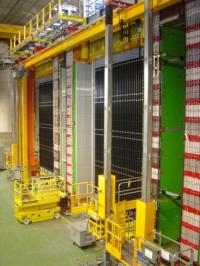
In the experiment named OPERA, run jointly by the CERN particle research centre near Geneva, Switzerland and the Gran Sasso Laboratory in central Italy, neutrinos were emanated from CERN and picked up by giant detectors in Gran Sassog, 731 kilometers away.
To cover such a distance, light would take 2.4 thousandths of a second, whereas the neutrinos took 60 nanoseconds, or 60 billionths of a second, less, according to a Reuters report.
“It is a tiny difference,” said Antonio Ereditato, spokesman for the researchers and also researcher at Berne University in Switzerland, “but conceptually it is incredibly important. “
The implication of the discovery is sensational. If the finding is proven to be true, in other words, the light-speed barrier could be overcome, time travel might not only exit in science fiction, but also be possible in reality.
But most physicists were skeptical about the discovery.
Physicists gathered at the CERN meeting in the wake of the announcement doubted the way they measured the distance between CERN and Gran Sasso Laboratory.
Detailed questions like whether they took into account the location of the moon and tidal bulges in the Earth’s crust were raised, according to a New York Times report.
It is still too early to jump to conclusions. Further scrutiny to the discovery should be undertaken.
http://news.xinhuanet.com/english2010/sci/2011-09/26/c_131160447.htm
(Agencies)
3 Questions: Faster than light?
September 26, 2011 by David L. Chandler
View of the OPERA detector (on the CNGS facility) with its two identical Super Modules, each one containing one target section and one spectrometer. Image: CERN
The news media were abuzz this week with reports of experiments conducted at the Gran Sasso particle detector complex in Italy, apparently showing subatomic particles called neutrinos had traveled from the giant particle accelerator at CERN, outside Geneva, to the Italian detector at a speed just slightly faster than the speed of light — a result that, if correct, would overturn more than a century of accepted physics theory. Professor of Physics Peter Fisher, head of MIT’s Particle and Nuclear Experimental Physics division, answered some questions about these new findings.
Award Winning Anti-Spam – Barracuda Spam & Virus Firewall 5 Star Rated by SC Magazine – www.barracudanetworks.com
Q. If this result is confirmed, does it really undermine Einstein’s theory of relativity, as some news reports claim? And if so, is there a theory that’s been proposed that might account for it?
A. Einstein’s theory rests on two postulates, one of which is that electromagnetic radiation travels at the same speed (the speed of light, 300,000 kilometers per second) no matter how the observer moves. Light particles — photons — have no mass, so a consequence is that no particle with mass can move at a velocity greater than light. These neutrinos have a tiny, but non-zero, mass and hence should not be able to travel faster than the speed of light.
There are theories that predict particles moving faster than the speed of light, but, to my knowledge, none of them account for all the other phenomena we have measured experimentally since the time of Einstein.
Q. What kind of other tests or independent experiments would it take to confirm this result so that it would be widely accepted?
A. There are two other experiments that shoot neutrinos over long distances that may have something to say about this result. One experiment is in the U.S., and the beam goes from Fermilab, near Chicago, to a detector called MINOS in northern Minnesota. The other shoots a neutrino beam across Japan to an experiment in a mine called Super-Kamiokande. The energies of the neutrinos in these experiments are much lower than the CERN beam, but they may have something to say very soon.
Q. If this turns out to be some kind of unrecognized systematic error in the measurements, would that reflect badly on the scientists who reported it, or would it just be a reflection of science working as it’s supposed to?
A. I would say more the latter. I know a number of the people on the OPERA experiment [at Gran Sasso] and they are very thoughtful, careful people who would never publish a result like this unless they were certain there was no better explanation. I would bet that whatever the explanation is, it will be very interesting.
Provided by Massachusetts Institute of Technology (news : web)
http://www.physorg.com/news/2011-09-faster.html


Deixe um comentário